Wednesday, December 22, 2021

Musing About Advice

Every now and then, readers will ask the common question about where I get ideas, or another author will ask how I publish several books each year. The answers are relatively simple:

1) My brain follows whatever thought comes to it, and my thinking is a tad warped.

2) I regard writing as a job and put my fanny in a chair and work, even when I don't want to.

No secrets.

However, I occasionally think about things I've learned in life that I wish someone would ask about. Or at least not roll their eyes if I suggest something. None of my thoughts are earth-shaking. For example: 

1) When working in the kitchen, keep the drawers closed. It's easier to wipe sticky stuff off the floor.

2) If you tie socks together before putting them in the washing machine, they are less likely to end up in the hozone (that part of the atmosphere where vanished socks hide). 

3) If you make a list, you get more done. If you lose the list, forget it.

4) Friendships may occur naturally, but retaining them takes effort, especially if you move away. It's worth the effort.

5) If you want to be remembered for something, do it well. Then draft your own obituary.

6) Write down family birthdays. They may be on the same date every year, but your brain wavers as you age.

7) Don't try to memorize any information you can easily look up. 

8) Learn to take and organize digital photos. They can bring you joy.

9) Every dime you save in your twenties will turn into at least a dollar when you're sixty. Lose the password to your savings account so you aren't tempted to take money out early.

10) It isn't worth it to go to bed mad. If you must, take a sleeping pill or you'll be awake for hours.

Aren't you glad you read this list? If you aren't, keep it to yourself.

                                                             *                 *                 *

To learn more about Elaine, go to elaineorr.com or sign up for her newsletter. 

Saturday, December 18, 2021

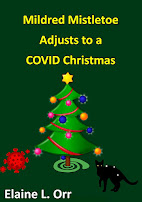
Mildred Mistletoe Adjusts to a COVID Christmas

Several years ago, I wrote about liking to have pets in my books but never writing a story from an animal's point of view. Over the next couple of weeks, I kept thinking, "Why not try?"

That led to Mildred Mistletoe, a black cat born in the manger under the family Christmas tree. I just completed the third story. I started it in 2020, but just couldn't get in the spirit to finish it. I certainly didn't think that in 2021 I'd publish a story called "Mildred Mistletoe Adjusts to a COVID Christmas."

But here we are, and it didn't feel right to ignore the stupid virus. At the same time, I wanted a story that offered at least a little encouragement without being syrupy.

And I do like Mildred. She's always a paw ahead of her humans.

https://www.amazon.com/dp/B09NQZFTF1

https://www.smashwords.com/books/view/1121160

https://books.apple.com/us/book/x/id1601331158 

https://www.barnesandnoble.com/s/2940165118005

https://play.google.com/store/books/details?id=zdNVEAAAQBAJ

                                                             *                 *                 *

To learn more about Elaine, go to elaineorr.com or sign up for her newsletter. 

Sunday, November 28, 2021

Can Income-Earning Authors Take a Break?

Can income earning authors take a break? The short answer is "no." The longer answer is "it depends." The more you earn, and can thus save, the longer you can take a break between books. 

It also depends on whether you used income from well-earning books to buy items (such as houses or cars) that require regular (high) payments.More expenses, higher earning threshhold required.

I make enough to pay many of my normal expenses. I'm fortunate, but I do work hard. 

I had a slow publishing period a couple of years ago and learned that my income does not stay consistent without at least three genre-fiction books per year. No complaints.

To reaffirm this premise, I recently downloaded sales and income data from Amazon and Smashwords (an aggregator that handles sales of most of my books for ibooks and Nook). 

I learned several things.

1) I do need to publish consistently or income drops quickly.

2) If I lower the price or give away the last book in a series before issuing the new one, sales of the new one are highter.

3) If I give away books on Amazon via Kindle Unlimited, it makes little difference in sales.

4) If I give away non-KU books on Amazon because of a price match with other sites, it not only helps sales but I get a lot of Amazon reviews.

5) If I keep the first box set of a series free on all sites but Amazon (via Smashwords), succeeding box set sales are very good. The moral here, for me, is to leave the first books free all the time. (The next two box sets are always in the top ten of box set sales, and have been number one or two at times. Other authors' sets come and go. My Jolie Gentil series stays high.)

6) Better to write some every day rather than try to crunch out three books at the end of the year. That's kind of a big 'duh,' but worth noting.

It's a good idea to pull historical data every year. You can obsess by examining data weekly or monthly, and it works better if you use that time to write.

                                                             *                 *                 *

To learn more about Elaine, go to elaineorr.com or sign up for her newsletter. 
Sunday, November 14, 2021

A Look Into the 'Real' World

When revising my website this year, I spent time considering how to describe my writing. Not in terms of genres, but how to put forth broader perspectives. This is what I came up with:

What makes Elaine’s fiction different from other traditional mysteries? Some might say the dry humor (only a few say lame), but she thinks it is the empathy her characters show to others. Fiction can’t ‘lecture’ readers. But it can contain people whose paths we cross every day — whether we know it or not. The bright colleague or grouchy neighbor who’s actually in severe emotional pain, the families struggling to provide enough food for their children, the vet with PTSD. 

While characters solve crimes or plan silly fundraisers, they can tacitly let us know there is a world beyond those activities. And maybe they can make it a little better.

I don't "have" to embody these ideas in stories, but they seem to arise naturally for me. The challenge is to convey the daily world in a way that fits in with the stories without implying that people should behave in a certain way.

Fiction offer the chance for characters to move beyond their routines. It's not every day a person falls in love, finds a body, or saves the world. While they're they're solving a crime, maybe there's a chance to show a little kindness. As long as things stay interesting.

                                                             *                 *                 *

To learn more about Elaine, go to elaineorr.com or sign up for her newsletter. 


Friday, November 5, 2021

What to Learn from Reviews of Your Books

Most authors I know read at least some of the reviews of their books. I've learned a lot from reading them, especially if a reader doesn't like something. 

I've talked a couple times about early reviews of the Jolie character in the cozy mystery series, set at the Jersey shore, that bears her name. In Appraisal for Murder, she's left a gambling husband and settled at her aunt's B&B as she reorganizes her life.

To me, it made sense that she was a tad sarcastic and more than irritated at her ex-husband. She also had a fling (a cozy, so not that kind of a fling) and focused on her own needs to a greater degree than she would in later books. 

These seemed like things someone might do if their life turned upside down. And if she found a woman dead in bed on her first day on a new job.

Readers commented some on the humor, a lot on Aunt Madge (whom they liked), and some on the pets. A number of reviewers liked the story but said Jolie was self-centered. I realized that while I created her to behave as a woman in her situation might, readers wanted a more likeable protagonist.

I had planned for her to eveolve as life got happier, but I changed more of her internal thinking than I might have had I not read the reviews. Less sarcasm, more dry humor. And as she gets more involved in the food pantry and life in Ocean Alley, she focused outwardly more.

As I wrote new series, I consciously made the protagonists more likeable -- or at least more relatable. Is this kow-towing to others' opinions? A bit. I write for me, I publish to entertain readers and make money. Readers have to like my genre fiction or they won't keep reading.

Mixing Mystery with Life

My next big learning experience was a head slapper. 

I am very critical of TV mystery series that devolve into soap operas. House was a good example. It started with such keen medical mysteries and eventually became the story of Dr. House's addiction and love life, plus various life and love events of other characters. Boring.

As the Jolie series has evolved, I've had reviews such as this recent one of Vague Images:

The mystery is sort of in the background but the relationships are what make books great. Full of friendships, family relations and a touch of romance. I had actually forgotten about the main mystery by the end but I enjoyed how it all wrapped up.

Gulp. 

On the other hand, here's a review of Mountain Rails of Old, the most recent book in the family history mystery series. Memorable characters and intriguing plot combine with genealogical research to make a fun read.

Lesson learned, perhaps not as consciously as I should have, but I do let the stories have a life of their own.

As with much of life, I suppose there has to be a middle ground.

                                                             *                 *                 *

To learn more about Elaine, go to elaineorr.com or sign up for her newsletter. 


Tuesday, October 26, 2021

Halloween and Books

Remember when Halloween became a holiday for adults? I do -- roughly the mid-1980s. I lived in the Washington, DC area at the time, and it was great fun to wander around Georgetown in costume.

Lots of classics deal with scary things. I suppose every mystery does, in a way. The best ones present situations you think you could actually find yourself in. And with most of them, it's the anticipation of the scare more than what actually happens.

The scariest story I remember was one of Sir Arthur Conan Doyle's Holmes Stories -- Adventure of the Speckled Band. One woman has died and her sister worries that she will be next. It's a classic, so I think a spoiler is okay.

Holmes' logic considers all options, but ultimately we learn that the evil murderer sends a snake through the air vents. It crawled down a bell-rope and bit the sister. Of course, it had to be a wealthy family, which would have a bell-rope to call servants. It's Watson's point of view, but my mind was "with" the sister, Helen, waiting for someone to kill her.

I was propbably twelve or so when I read it, and I had to sleep with a light on for a week or more! That's a sign of a truly scary story. And we certainly didn't have a bell-rope.

If you're looking for other spooky stories, I recommend The Legend of Sleepy Hollow, by Washington Irving and Will Moses. Agatha Christie's Hallowe'en Party: A Hercule Poirot Mystery is intriguing, but not the kind of story to make you look over your shoulder.

If you want some new stories, check out Trick or Treats: Tales of All Hallow's Eve (A Speed City Crime Writers Anthology). I like the way this SINC chapter describes the holiday -- All Hallows’ Eve, when the veil between the afterlife and this life thins, and the night fills with wonder and dread.

                                                             *                 *                 *

To learn more about Elaine, go to elaineorr.com or sign up for her newsletter. 

Friday, October 15, 2021

Positive Delay Tactics --- Maybe

I believe that the best way to write enough to publish is just to keep writing. Well, duh. What does that mean?

Ideas for stories come fairly easily. What does not come eaily is bringing those ideas to fruition in a story that matteres -- and all good stories matter, whether they deal with a serious topic or something that may be thought of as frivilous.

Sometimes you reach a point and realize a story has nowere to go. It's buried in the "maybe later" file and you go on to something else. If that happens too often, it may mean your "keep your buns in a chair" gene is not working properly. My gene has been known to wander.

Writers have different indicators for when a story is stalled. We may:

  • Have characters repeat (to another character, or while ruminating) recent action. As if repetition will clarify where what should come next.
  • Start a new chapter or scene with a phrase such as, "The next day dawned bright/cloudy..." Moving action forward without showing the transition because, well, how did we get there?
  • Have characters deal with daily life beyond what's needed to move the story along. Mindless activity may help an author think, but it loses readers.
  • And the tried and true distraction, clean something in one's own home.

I used to place characters on a bus or train. In Falling Into Place, I have the grandpa accompany a sick child home from school on a city bus -- because he wasn't sure what they'd do when they got to his place.

In Toxic Traces (which will never see the light of day) I put several characters on the D.C. subway. As if that would get to the next plot point. In both cases, I took long breaks from the stories as the characters got their bearings.

These were early books. Now I know I can't stop. I always have ideas for scenes, so I'll write a few paragraphs or pages even if I don't know how they'll fit into the story. I generally use the scene in some way, but even if I don't, the process of putting pen to paper has continued. 

Of course, those who outline carefully before starting Chapter One will say, "See, this is why you outline." I do make notes as I start and along the way, but I'm way too impatient to outline. One of these days a diversion will waste too much valuable time. In the meantime, I enjoy the ride.

                         Soon after I wrote this, I read K.M. Weiland's new post, 6 Questions to Help You Avoid  Repetitive Scenes. I commend it.

                                                                *                 *                 *

To learn more about Elaine, go to elaineorr.com or sign up for her newsletter.